
Business schools are uniquely positioned to shape the leaders, research, and communities of tomorrow.
This three-day Social Impact Workshop empowers professionals to turn social value creation into a guiding force within their institution’s ethos.
Through facilitator guidance, cases from practice, collaborative peer exchange, and the use of a purpose-built Social Impact Canvas, participants will leave with a clear, practical plan to advance impact within their own schools.
Over the course of the programme, participants will explore how to:
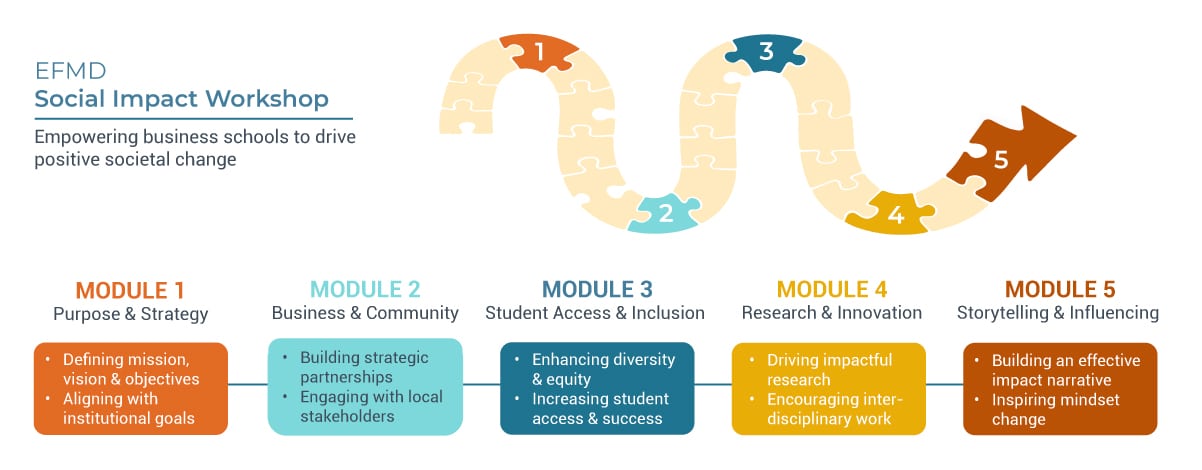
Each module combines structured input with opportunities for reflection, practical exercises and peer learning, ensuring participants leave inspired, confident and ready to lead positive change.
METHODOLOGY
Far from being a conference of abstract ideas, the workshop is designed as a highly interactive and hands-on experience. Participants will work with a Social Impact Canvas specifically developed for this training. Participants will map their school’s current position, their role and sphere of influence, identify opportunities, and design actionable next steps to bridge the gap between theory and real-world application. By the end, participants will walk away with actionable items they can then implement in their daily professional lives.
The Social Impact Workshop is designed for Business School Programme Directors, Associate Deans, Quality Assurance officers with responsibility for Sustainability, SDGs, Equality, Diversity, and Inclusion, Heads of Department, and other roles that have strategic oversight of a relevant portfolio of activities.
Participants who successfully complete the workshop will receive a digital badge, fully verifiable and shareable online. The certificate recognises their commitment to professional growth and their contribution to advancing excellence in management education.
Unable to attend this year but interested in future editions? Select “Keep me informed” to stay updated.
08:40 – 08:50
Registration & welcome coffee
08:50 – 09:00
Welcome & Introduction to the Programme
09:00 – 09:30
Setting the scene: Building a business school for social impact through a purpose-driven approach
9:30–11:00
Point Zero: Profiling your social impact strategy and journey through purpose
This opening session sets the foundation for the rest of the programme. It invites participants to pause and identify Point Zero. Using the Social Impact Canvas, participants will map their institution’s current position in its social impact journey: clarifying purpose, identifying strengths, and surfacing gaps between aspiration and practice. By the end, each participant will have a visual profile of their current impact strategy – an anchor point from which the rest of the workshop builds. This shared starting framework enables honest conversation, peer exchange, and a clearer sense of direction for embedding purpose more deeply into organisational DNA.
11:00–11:30
Networking Coffee Break
11:30–12:30
Module 1: Purpose as a strategic approach to Social Impact Part 1
This session focuses on how a clear institutional purpose can anchor and strengthen a business school’s social impact strategy. Participants will reflect on how vision, value proposition and guiding principles shape culture, priorities, and societal contribution. Through short activities, they will have an opportunity to reflect on their own institutional purpose narrative, ensuring it aligns with their school’s identity and aspirations. By the end, participants will have a concise foundation for a purpose-led strategy that informs decisions and future impact initiatives.
12:30– 14:00
Lunch
14:00– 15:00
Module 1: Purpose as a strategic approach to Social Impact Part 2
Building on Part 1, this session focuses on translating purpose into priorities. Through brief exercises and peer discussion, they will stress-test their purpose narratives and explore how these can guide strategic decisions and impact priorities. By the end, participants will have a clearer, more actionable foundation for embedding purpose into their school’s social impact strategy.
15:00– 15:30
Networking Coffee Break
15:30– 17:00
Module 2: Business & Community engagement
This session explores how partnerships with businesses, public bodies, and community organisations enhance a school’s social impact. Participants will look at models of effective collaboration and consider how their own institutions can build stronger, more inclusive relationships with key stakeholders. Through stakeholder mapping, they will identify opportunities for shared value and more sustainable engagement. The session concludes with participants outlining priority partnership actions that can deepen community impact and better connect their school to its wider ecosystem.
*Opendot, a Milan-based open innovation and design research lab, works at the intersection of technology, social inclusion and community co‑creation. Its projects demonstrate how participatory approaches and cross‑sector collaboration can generate meaningful social impact and scalable solutions.
19:00-21:30
Welcome dinner
9:00-9:30
Transfer to MOSSO Milano
9:30-11:30
Module 2: Business & Community engagement: Immersive experience
A key feature of the learning experience is an impact tour, where participants engage directly with local stakeholders and gain first-hand insight into local community and business engagement. The immersive experience is designed to move learning beyond the classroom, adding texture and context. The module emphasises practical application and peer exchange, creating space to develop actionable ideas that support meaningful engagement between business schools and their wider communities. Participants will explore how business schools can work more effectively with external partners to create social value while strengthening the local ecosystems they are part of.
The 2026 impact tour introduces participants to MOSSO Milano*, exploring how its collaborative model leverages partnerships with businesses to generate meaningful social impact in the local community. Through an immersive visit and project presentations, participants will examine how cross‑sector engagement can activate inclusive neighbourhood transformation.
*MOSSO Parco Lambro is a community space nestled within one of Milan’s most significant urban parks, dedicated to social inclusion, environmental education and participatory regeneration. The hub hosts cultural, educational and community‑driven initiatives that engage residents, civil society and businesses in co‑creating accessible public spaces and local wellbeing.
12:00-13:00
Lunch
13:00-15:00
Module 3: Social Impact for Student Success
This session explores how business schools can create more inclusive environments by learning from organisations outside academia that are successfully supporting individuals from diverse ethnic, social, and cultural backgrounds. Drawing inspiration from these external examples, participants will reflect on how their own institutions can better foster inclusion and equity. The session will culminate in the development of an action plan to enhance social impact outcomes for students, ensuring they graduate with a strong sense of civic responsibility and preparedness for leadership in an increasingly diverse society.
15:00-15:30
Networking Coffee Break
15:30-17:30
Module 4: Impactful research & innovation
The role of business schools in driving societal impact became more apparent after the 2007 global financial crisis and more critical as the world grapples with achieving the Sustainable Development Goals (SDGs) and other environmental, social and governance issues. By learning from organisations outside academia, this session will explore how business schools can further embed societal impact into their research/scholarship and innovation projects through interdisciplinary work. The session will guide business school leaders into building a plan and engaging in impactful research and innovation projects, demonstrating tangible societal improvement.
*Fraunhofer Italia is a non-profit applied research organisation based at NOI Techpark in Bolzano, operating as the first independent foreign branch of the Fraunhofer-Gesellschaft in Italy. Founded in 2009 with the support of Assoimprenditori Alto Adige and the Autonomous Province of Bolzano, it focuses on innovation engineering for industry and society. Its ARENA application centre provides a dedicated space where researchers collaborate with public and private stakeholders to advance digitalisation and sustainability through applied research.
19:30-22:00
Networking Dinner
9:00-11:00
Module 5: Social Impact storytelling & influencing /Leading mindset transformation
This session will explore how business schools frame their social impact narrative to facilitate effective communication with key stakeholders and to co-create social impact with partners and collaborators. The session will address educational impact (including student and alumni-led ventures for social impact), research impact and business development impact and will include four case studies of effective social impact storytelling. Participants will be encouraged to consider according to their priorities and contexts.
11:00-11:30
Networking Coffee Break
11:30-12:15
Building an action plan (Future aspirations)
12:15-12:30
Conclusion & Wrap-up






Early bird fee until 02 March 2026 included
Registration fee as of 03 March 2026
Cancellations must be confirmed in writing. If EFMD is notified of your withdrawal by 23 March 2026, an administrative cancellation fee of 75€ + local VAT will apply. After this date, we regret that no refunds can be issued. However, substitutions are allowed at no additional cost, provided EFMD is informed of the substitute’s name, title, and address. Event fees are not transferable to other EFMD events.
Please note that if payment (or proof of payment) is not received by 17 April 2026, your name will not be included in the participants’ list.

POLIMI Graduate School of Management
Navigli Campus
Ripa di Porta Ticinese, 77
20143 Milano
Italy


